As Chinese EV brands gain ground, legacy carmakers struggle to adapt
As Chinese EV manufacturers expand worldwide, legacy automakers face growing pressure to compete on technology, scale and cost.
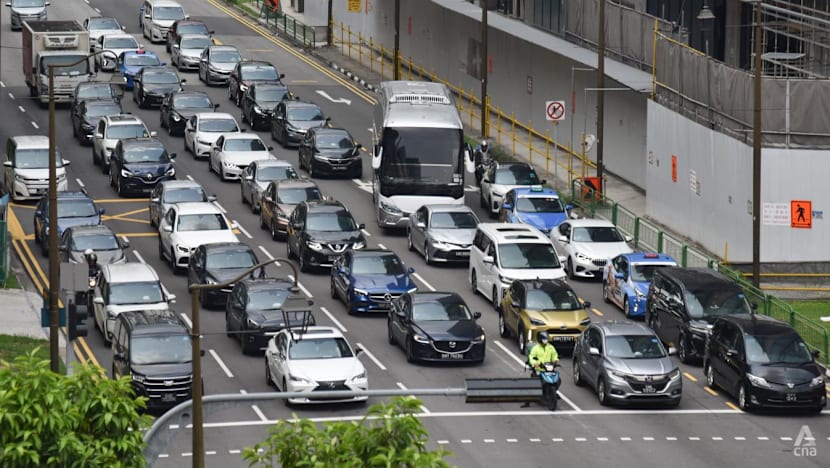
Vehicles in Singapore. (File photo: ²İİ®´«Ã½/Syamil Sapari)

This audio is generated by an AI tool.


SINGAPORE: For much of the 2000s and 2010s, the global auto industry was dominated by the same handful of Japanese, German and American manufacturers.
No Chinese manufacturer entered the top tiers of global vehicle production, while Tesla remained a niche player.
Rapid growth in China helped fuel record sales and profits for many of these legacy brands, and the industry's centre of gravity began shifting in the 2020s.
While Japan's Toyota and Germany's Volkswagen Group remain the world's two largest automakers, Chinese electric vehicle (EV) manufacturers led by BYD have begun to rapidly gain global market share.





The cracks are beginning to show.
Honda Motor posted an operating loss of around 400 billion yen (US$2.55 billion) for the past financial year, its first in close to 70 years. Nissan announced in May 2025 that it would close factories and cut about 20,000 jobs globally amid weak sales in the US and China, and said last month it would cut 900 jobs in Europe.
In Singapore, the shift has been stark – BYD overtook Toyota as the country's most popular brand in 2025.
²İİ®´«Ã½ analysed the market share of eight car brands over 12 years, selecting each because it ranked among Singapore's top three best-selling marques at least once during the period.
The fortunes of Singapore's six leading legacy brands have diverged. Mass-market brands – Toyota, Honda, Nissan and Mazda – saw market share decline from 2016 to 2025, while the two luxury marques, Mercedes-Benz and BMW, held steady or edged up.
Yet their performance was overshadowed by the rise of newer EV brands.
BYD's market share in Singapore climbed from 2.5 per cent in 2022 to 21.2 per cent in 2025, while Tesla's grew from 2 per cent in 2021 to 6.6 per cent in 2025.
The EV transition "opened a window of opportunity" for new players, said Professor Martin Krzywdzinski, director at the Weizenbaum Institute in Berlin and an expert in the automobile industry.
That growth was "compounded by misjudgments on the part of legacy manufacturers regarding the pace of change and, above all, the speed at which Chinese companies would develop competitive vehicles".
TOO LATE TO REACT
The key driver behind the rise of new EV entrants was their early, large-scale investment in electric mobility, Prof Krzywdzinski said. Tesla pioneered key battery innovations and the "software-defined vehicle", shifting customer expectations of what a car could do.
“Chinese companies followed this path, supported by China’s systematic industrial policy, which has led to the emergence of a very strong battery manufacturing sector,� he said.
That policy encompassed charging infrastructure, subsidies for local buyers, and support for battery manufacturers and component suppliers.
China's massive investments in scale proved difficult to match, while many legacy manufacturers were slow to respond. EV adoption in Europe and the US has been slower partly because those markets invested far less in infrastructure and lacked an active industrial policy to support the EV transition, Prof Krzywdzinski said.
Legacy carmakers also underestimated the Chinese market, and continued to build their own expertise in the internal combustion engine or petrol car sector.
Professor Stefan Bratzel, director of the Center of Automotive Management in Germany, said established manufacturers also relied on "incremental improvements to existing business models" and underestimated the strategic importance of electrification, software and platform economics.
“Many mass-market brands have reacted, but often too late, too cautiously, or with products that were not convincing enough in terms of price and technology,� he said.
Customers now expect an "attractive overall package" that competes on price, range and charging performance.
“This is where the industry’s winners and losers are currently being separated,� he said.
CAN CHINESE GROWTH BE SUSTAINED?
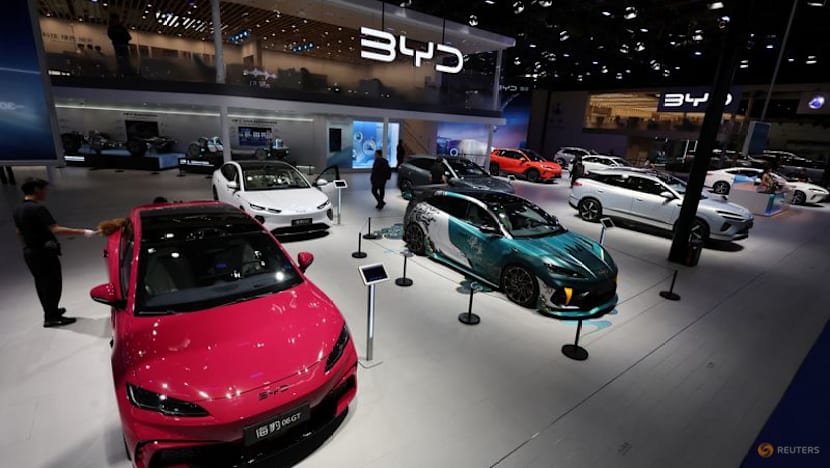
The Chinese brands that have expanded into markets like Singapore did not do so by accident, said Dr Terence Fan, assistant professor of strategy and entrepreneurship at Singapore Management University.
“The Chinese brands that have come to Singapore are the survivors,� he said, noting that many Chinese companies have failed domestically.
“For them to survive, they must have a huge scale to reduce cost of operations and sell at a lower price point. If you can win in the Chinese market, you can win in many other markets.�
Prof Krzywdzinski cautioned that new entrants from China could still face "significant problems" as competition intensifies. New entrants are selling vehicles that are "barely profitable" to stay competitive – a strategy that may not hold.
Resale value is another concern. "Many customers will soon realise that the resale value of many Chinese EVs is very low, whereas the higher build quality of legacy manufacturers and their strong brands protect against significant depreciation," he said.
Even so, both analysts said the rise of Chinese automakers represents a structural shift, not a temporary disruption.
AUTOMAKERS FOCUSING ON HYBRIDS
Mass-market brands say they are offering consumers a range of powertrain options rather than betting on a single technology.
Borneo Motors, Toyota's authorised dealer in Singapore, said consumer demand continues to favour hybrids, adding that the figures "speak for themselves and strongly validate that our strategy aligns with actual market demand".
In the first five months of 2026, Toyota recorded 2,708 new hybrid registrations, 45 electric and 95 petrol.
“Hybrids represent practical, scalable electrification today. They offer immediate carbon emissions reduction without requiring any shift in consumer behaviour or reliance on public charging infrastructure, which is still scaling up,� a spokesperson said.
Still, Borneo Motors said it will maintain a "multi-pathway approach" and invest in both hybrids and EVs to provide consumers with more options.
Honda agent Kah Motor's chief executive Nicholas Wong said sales figures show a "sizable number of customers who prefer petrol cars".
Honda recorded 325 petrol and 737 hybrid registrations in the first five months of 2026, and no EV sales.
“There is still a lot of satisfaction derived from driving a petrol-engine car and the numbers are a testament to that,� said Mr Wong. “Customers are also aware that this would be their last chance to buy a petrol-engine car before 2030.�
Honda's latest EV, the Super-ONE EV, was launched in Japan in May and has since gone on sale in Singapore.
Nissan and Mazda did not reply to ²İİ®´«Ã½'s queries on how they are adapting to the EV shift.
LUXURY BRANDS STANDING STRONG – FOR NOW
While mass-market brands have lost ground, luxury marques have held steady or grown.
BMW's market share in Singapore rose from 6.2 per cent in 2015 to 9.7 per cent in 2025. Mercedes-Benz's share was 9.4 per cent in 2015 and 9.2 per cent in 2025.
Mr Rene Gerhard, managing director of BMW Group Asia, said that while new entrants compete strongly on price and innovation, BMW is focused on premium branding.
“We welcome stronger competition because it pushes the industry forward, but we remain disciplined in our approach, continuing to focus on delivering a truly distinctive premium experience that goes beyond specifications alone,� he said.
Mr Marcel Mustelier Perez, president and CEO of Mercedes-Benz Singapore, said customers choose the brand on more than price.
“They are making a decision about the kind of ownership experience they want, and that is something built over 140 years, not replicated overnight.�
The premium marques have been largely insulated because Chinese brands compete mostly in the mass market segment, said Associate Professor of Practice Victor Kwan at the Singapore University of Social Sciences, who spent 20 years in the automotive sector before joining academia.
"Brand equity is something intangible and has to be built over time with history, evolving identities," he said. "It will take a while for Chinese brands to build up their own aura of prestige."
But as Singapore and other markets move towards mandating full EVs, luxury brands will have "no choice but to try to compete in the electric space", Dr Kwan said.
He noted that premium brands have so far struggled to justify a price premium for their EVs – partly because EVs are "essentially computers on wheels" with little differentiation on engineering or driving characteristics.
“Their traditional advantages will definitely become weaker,� he said.
But analysts said the long-term challenge facing automakers extends beyond competition in any single market segment.
“Not all new EV manufacturers will succeed in the long term, but the balance of power is clearly moving toward companies that systematically combine electrification, software, cost leadership and direct customer access,� said Prof Bratzel.
“The decisive question will be which manufacturers can transform from traditional vehicle producers into technology and service-oriented mobility providers, and which remain trapped in the old industrial paradigm.�